

Choose your pack
Pick the data and validity that suit your Japan trip.


Continue your journey
More real packs that can keep you connected beyond this destination.
Japan is one of the most connected countries on earth — and one of the trickiest places to casually buy a SIM card. Local carriers generally don't sell ordinary SIMs to short-term visitors: tourist options are limited to airport counters, vending machines, and electronics stores, usually at tourist prices and often with registration steps. Free WiFi exists in convenience stores and stations but drops constantly as you move.
That's why Japan became the country that made travel eSIMs popular. Install before you fly, land at Narita, Haneda or Kansai, switch on data, and you're on a real Japanese network before you reach the train platform — no counter, no queue, no rental device to return.
Pocket WiFi rental is a Japanese institution, but it made sense in the era before eSIMs. A pocket WiFi is another device to carry, charge every night, collect at a counter and return on departure day — with late fees if your flight changes. Typical rentals run $4–8 per day, so a two-week trip costs $56–110. An eSIM lives inside your phone, costs a one-time $1.99–$50.99 depending on data, can't be forgotten in a hotel room, and needs no return. If you need to share data with a companion or laptop, every ElloSim Japan plan supports hotspot/tethering — your phone is the pocket WiFi.
Pocket WiFi still makes sense for groups of four or more sharing one connection all day. For solo travelers and couples, an eSIM does the same job for a fraction of the price.
Japan trips burn more data than people expect — not from streaming, but from constant small uses: Google Maps replanning train routes, translation apps reading menus, IC-card top-ups, photo backups on the go.
1 GB / 7 days ($1.99) suits a short city hop where hotel WiFi does the heavy lifting. 3 GB / 30 days ($3.99) covers careful users on a one-to-two-week trip. 5 GB / 30 days ($4.99) is the sweet spot with a prepaid data allowance for most itineraries with normal social media use. 10 GB / 30 days ($7.99) is our most popular Japan plan: real-time photo sharing, video calls home, and navigation-heavy days in Tokyo and Kyoto without watching the meter. 20 GB and 50 GB suit remote workers, long stays, and laptop tethering — the 50 GB plan is priced in the current plan selector, pocket-WiFi capacity without the pocket WiFi.
If you run low, every plan supports top-ups from your order page — no new QR, no reinstall.
Your eSIM is data-only, and that's by design: WhatsApp, LINE, iMessage and FaceTime all keep working on your normal number, because that number stays attached to your physical SIM. Japan essentials worth installing before you fly: Google Maps (its Japanese train routing is excellent and data-hungry), Google Translate with the camera function for menus and signs, and Suica or PASMO in Apple Wallet / Google Wallet — topping up your transit card from your phone uses your eSIM data and saves you from station ticket machines.
One detail unique to travel eSIMs: check the Internet IP badge on your chosen plan. Most Japan travel plans route internet traffic through a regional gateway (commonly Hong Kong or Singapore), which is normal for this product category and irrelevant for maps, messaging and browsing — but some streaming services may treat you as outside Japan. If region-accurate streaming matters to you, pick a plan whose badge shows a Japan IP.
In Tokyo, Osaka, Kyoto and every city in between, expect strong 4G/5G — Japan's networks (NTT docomo, KDDI/au, SoftBank, Rakuten) are among the world's best. On shinkansen routes coverage holds up well, including through most tunnels. The honest caveat: deep mountain valleys, remote onsen towns and long rural hiking routes can drop to slower signal or dead zones on any network, local SIMs included. Download offline maps for rural day trips and you'll barely notice.
Three simple steps
Pick the data and validity that suit your Japan trip.
Your QR arrives by email. Check the selected plan before installing.
Check when your selected plan starts before you travel.
Compare
Travel eSIMDigital QR delivered by email or instant QR code on your device
Physical SIMA physical card must be collected or delivered
Travel eSIMInstall in phone settings before travel
Physical SIMInsert and store a removable card
Travel eSIMChoose and buy online
Physical SIMAvailability depends on local sellers
Travel eSIMRequires an eSIM-compatible, unlocked device
Physical SIMRequires a compatible physical SIM slot
A little help, when you need it
Need help choosing a pack or getting connected? We’re just a message away.
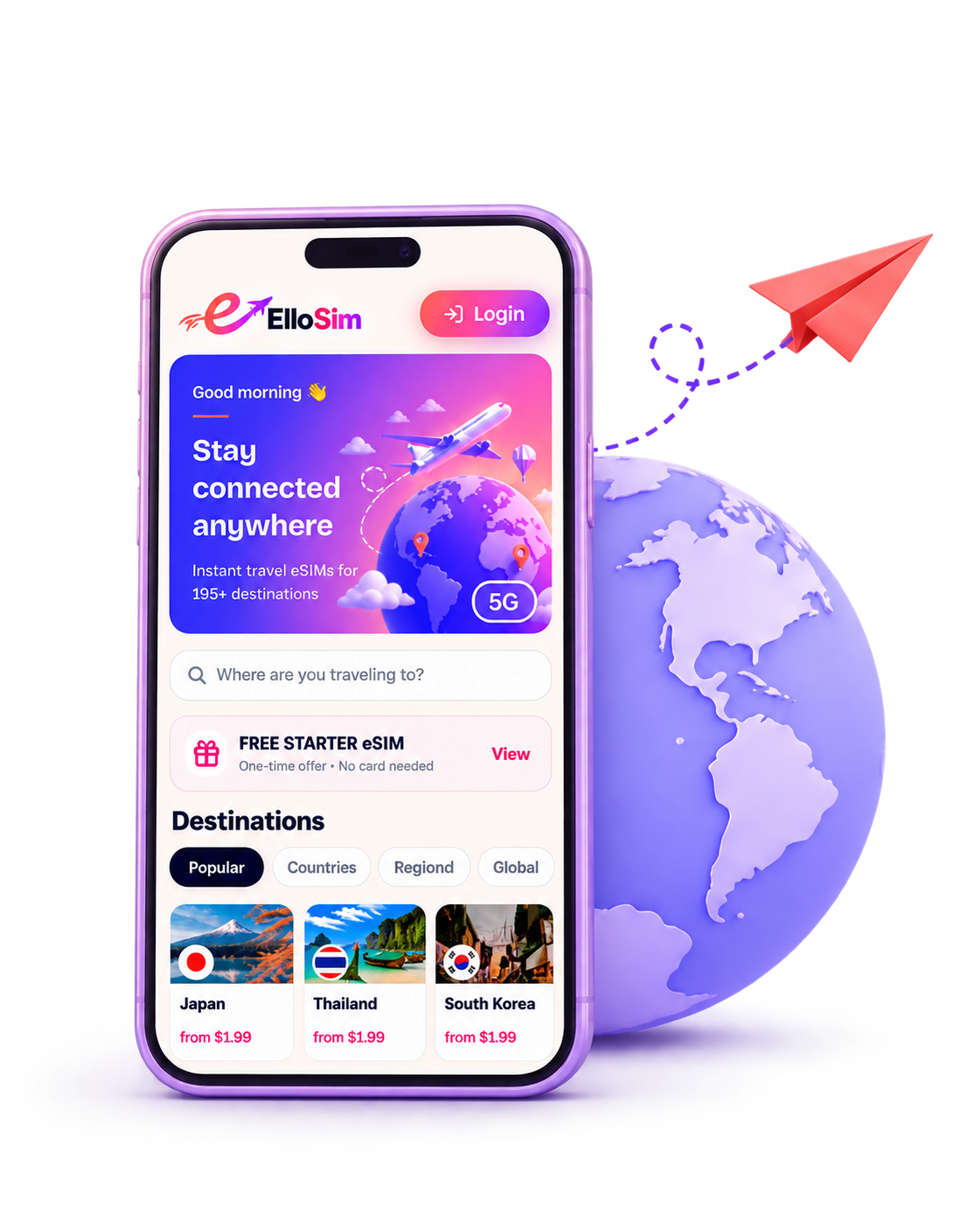
The ElloSim app
Buy eSIMs, check your data and top up on the go.