iSIM vs eSIM: Is iSIM the Future of Travel Connectivity?
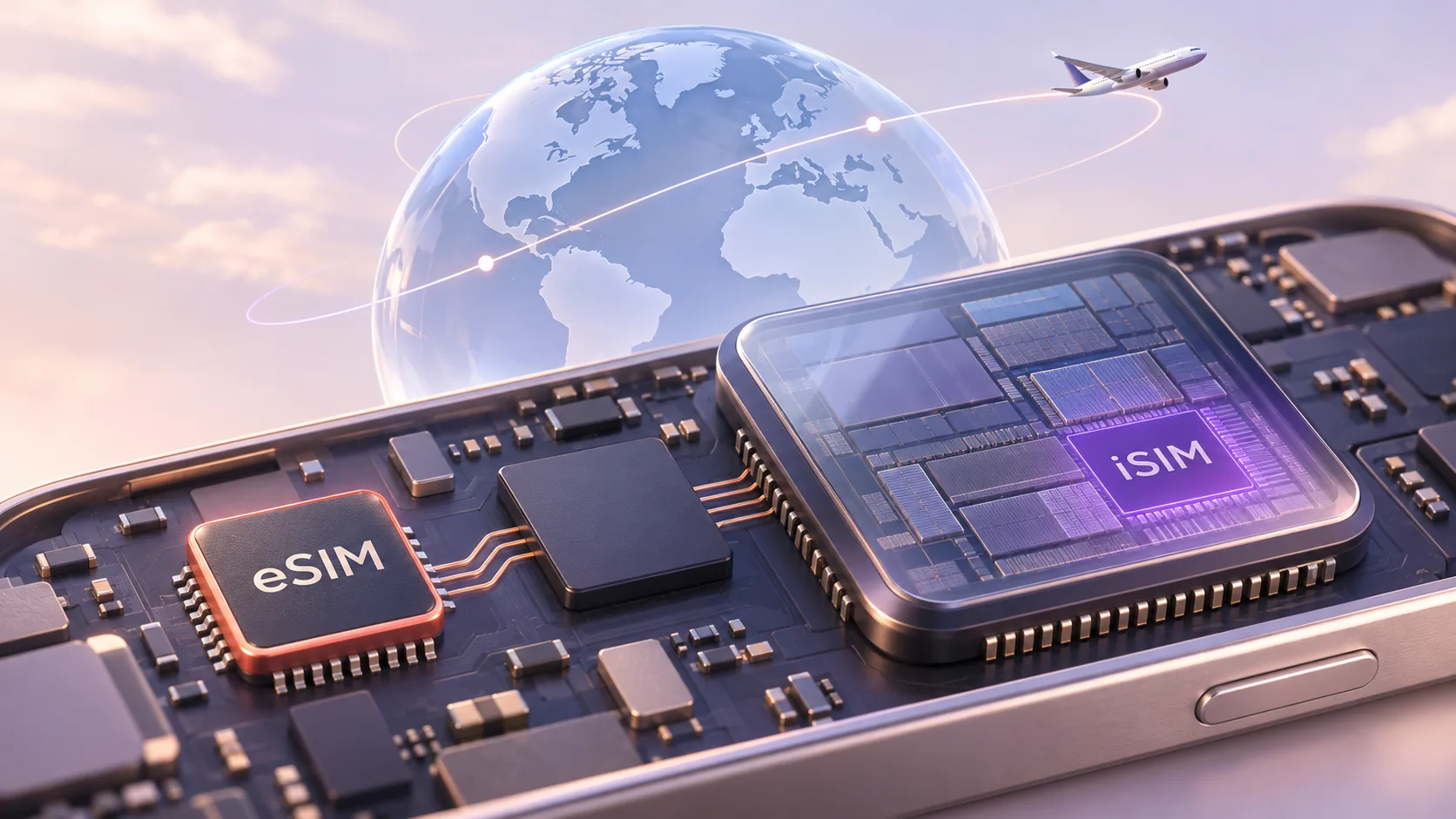
iSIM changes where SIM functionality lives inside a device. It does not, by itself, give you cheaper roaming, faster data or access to every mobile network. For a trip you are booking now, confirmed device compatibility and the details of your data plan matter more than a new acronym.
If you already use an eSIM when you travel, iSIM can sound like another upgrade you need before your next trip. The more useful question is whether your exact phone supports the travel plan you want to install.
Here is how the technologies fit together, where iSIM is already commercially available, and what travelers should check before buying.
What is the difference between iSIM and eSIM?
In a typical eSIM phone, a dedicated chip securely holds the mobile subscription profiles that let the device connect to an operator. An iSIM integrates that secure SIM functionality into a system-on-chip, rather than using a separate SIM component.
There is an important terminology detail: eSIM describes a broader remote-provisioning ecosystem, not just a soldered chip. An integrated SIM can be an implementation of that ecosystem. The Trusted Connectivity Alliance explains that eSIM can use removable, embedded or integrated hardware.
Put simply, “embedded” and “integrated” describe different ways of building the capability into a device. Remote provisioning describes how the subscription profile gets there. Read the Trusted Connectivity Alliance’s explanation.
For travelers, this means a future change inside the phone need not create an entirely new way to shop for mobile data. But support still has to exist across the device, its software and the service provider.
iSIM vs eSIM at a glance
Here, “eSIM” means the separate embedded SIM chip commonly used in phones. More broadly, eSIM is the remote-provisioning ecosystem, which can also include iSIM.
| What matters | Typical phone eSIM | iSIM |
|---|---|---|
| Where it lives | A dedicated secure chip inside the device. | Secure SIM functionality integrated into the main system-on-chip. |
| Hardware changes | Built into a compatible phone; no removable SIM card is needed. | Must be implemented in the device hardware. Downloading a profile cannot turn a separate eSIM chip into iSIM. |
| Installing a plan | Follow the provider’s supported setup, such as a QR code or on-device activation. | Supports remote provisioning on compatible implementations; the actual setup depends on the device and provider. |
| Moving to another phone | Transfer or reissue depends on the devices, software and provider. A travel plan is not automatically transferable. | Integration does not guarantee easier transfers; confirm the finished device and provider’s rules. |
| Availability today | Available on many supported consumer phones, with regional and model differences. | Commercial examples include IoT modules. A certified chipset alone does not confirm support in a retail phone. |
| Speed and reception | Depend on the phone’s radio, network, coverage and plan. | Integration alone does not guarantee faster data or better reception. |
| Battery and space | Uses a separate component; whole-device design determines battery life. | Can save component space; do not assume a particular battery-life gain in your phone. |
| Using a travel plan | Check the exact model, regional version, unlocked status and plan compatibility. | Confirm explicit device and provider support. The iSIM label alone does not establish travel-plan compatibility. |
For your next trip: choose a plan your actual phone supports. iSIM is a hardware development, not a reason to replace a compatible eSIM phone.
Sources: TCA’s eSIM hardware overview, Qualcomm and Thales on integrated SIM and remote provisioning, Soracom’s commercial IoT launch, and Apple’s device and provider requirements for transfers.
Why manufacturers are interested in iSIM
Removing a separate SIM component can free up space and simplify manufacturing. That is especially attractive for small connected devices, where board space, battery consumption and component costs matter.
Giesecke+Devrient and Sony Semiconductor Israel described these benefits when they announced a commercial iSIM solution based on Sony’s ALT1350 chipset in September 2023. Their solution places the SIM operating system within protected hardware inside the chip and supports remote SIM provisioning. See G+D’s announcement.
Those engineering benefits should not be translated into a promise of a particular battery-life improvement on your phone. The effect depends on the complete device. Likewise, a smaller SIM implementation does not establish better reception or a faster mobile connection.
Where iSIM is already commercially available
iSIM has moved beyond laboratory demonstrations in the Internet of Things, or IoT: connected equipment such as trackers and meters.
Soracom announced the commercial launch of its iSIM technology and a module based on the Murata Type 1SC on 23 January 2025. The collaboration included Sony Semiconductor Israel, Murata and Kigen. Read Soracom’s commercial launch announcement.
Soracom’s Japan-region announcement also lists the Murata Type 1SC and Quectel BG773A-GL iSIM modules among products available through its user console. These are cellular IoT modules, with LTE-M and NB-IoT connectivity, sold for integration into connected products. See Soracom’s module availability details.
These are concrete examples of commercial iSIM hardware. They are not travel phones, and their availability does not tell you whether a consumer handset can download a particular holiday data plan.
Why a certified chipset does not confirm an iSIM phone
In February 2023, Qualcomm and Thales announced a commercially deployable, GSMA-certified iSIM on the Snapdragon 8 Gen 2 Mobile Platform. This was an important platform milestone. Read the Qualcomm and Thales announcement.
It is still necessary to distinguish three things:
- A chipset can support the technology.
- A manufacturer can implement and enable it in a finished device.
- A service provider can support that device and its subscription setup.
The first does not establish the other two. A phone containing Snapdragon 8 Gen 2 should not automatically be described as an available iSIM phone.
The same caution applies to demonstrations. Qualcomm’s January 2022 announcement described a proof of concept based on a Samsung Galaxy Z Flip3 5G. It did not establish iSIM support for every retail Galaxy Z Flip3. Read the original smartphone demonstration announcement.
For a purchase decision in November 2026, look for explicit support for the finished phone model and regional version. A certification announcement, forecast or familiar chipset name is not enough.
What to check before your next trip
Start with the phone you will actually carry. Confirm its exact model and regional version, check eSIM support, and make sure it is unlocked for use with another provider. Apple’s international travel guide, for example, explains that using another carrier requires an unlocked iPhone and notes regional differences in eSIM support. Read Apple’s travel guidance.
Next, check the plan rather than relying on the SIM label. Our fixed-data versus unlimited eSIM guide explains the conditions worth comparing. Does it cover every destination on your itinerary? How much data is included? When does validity begin? Are calls and texts included, or is it data only? These are the details that determine whether a plan fits a weekend away or a multi-country trip.
Follow the installation and activation instructions for the plan you buy. ElloSim provides setup details by email and asks customers to use an eSIM-ready, unlocked phone. Its destination listings show data allowances, validity and plan conditions. Browse ElloSim travel eSIMs.
Finally, review which line your phone will use for mobile data. Keeping your home line active can still lead to charges under your home operator’s roaming rules. Adding a travel eSIM does not automatically make every call, text or connection free. Apple also warns that using both lines abroad can incur home-line roaming fees. Check Apple’s guidance on using a travel eSIM.
Frequently asked questions
Is iSIM the same as eSIM?
They overlap, but the terms describe different aspects of the technology. iSIM refers to integrated SIM hardware. eSIM is commonly used for remotely provisioned subscriptions and the technology behind them, including integrated implementations.
Can I upgrade my existing phone to iSIM?
Downloading a profile does not change the physical design of your phone. Whether integrated SIM hardware exists and can be enabled is a question for the device manufacturer. Do not assume an app or software update can add it.
Will iSIM make mobile data faster?
There is no automatic speed upgrade from changing the SIM’s form factor. Judge a connection by the phone’s radio capabilities, the available network and the plan’s service conditions, rather than by whether the SIM is integrated.
Can I use an ElloSim plan on an iSIM device?
Do not assume compatibility from the iSIM label alone. Check ElloSim’s device guidance and confirm support for your exact device before buying. An IoT module or chipset certification is not confirmation that an ElloSim travel profile will work.
Should I wait for iSIM before buying a travel eSIM?
If your existing phone is compatible, unlocked and supported for your chosen plan, you do not need to wait for iSIM to prepare for your trip. Choose around the trip you are taking and the device you own.
Get your travel connection ready
Before you fly, check your phone’s compatibility, choose the coverage and data allowance you need, and follow the plan’s setup instructions. Find an ElloSim plan for your destination.
More in eSIM Advice

Using a Travel eSIM on a Cruise: Port Days vs Sea Days
Plan your cruise connection in two parts: travel eSIM data for supported ports and a separate setup for sea days. Here is what to check before you sail.

Bank Verification Texts Abroad with a Data-Only eSIM
Bank codes go to the number on your account, not your travel eSIM. Here is how to keep your home line ready for texts while the eSIM handles data, plus questions for your carrier and bank.

eSIM Installed but No Internet? What to Check First
Your eSIM is installed but nothing loads. Work through these calm, step-by-step checks on iPhone and Android, and learn why deleting the eSIM should never be your first fix.